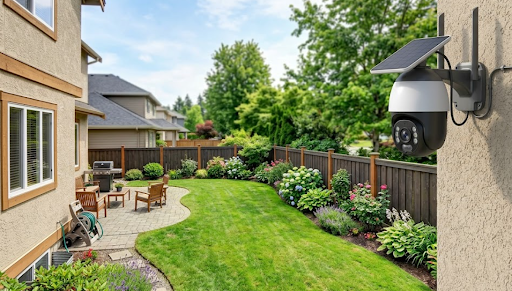

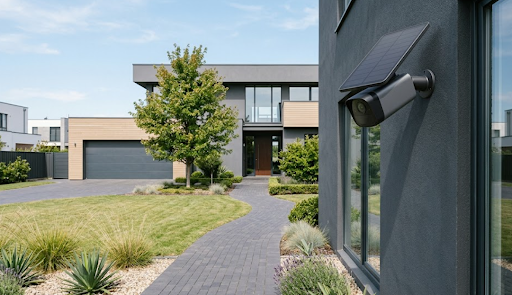
The best AI security camera uses onboard artificial intelligence to distinguish between people, vehicles, and animals in real time, eliminating false alerts and delivering only the notifications that actually matter. KeldCo's Solar Camera Pro 2.0 4G and Solar Camera Pro 3.0 WiFi lead the category with AI-powered smart detection, solar-powered operation, and local SD card storage that never charges a monthly subscription fee.
Standard motion detection treats every trigger the same way. A blowing leaf, a passing cat, and an actual intruder all generate identical alerts, which means you either ignore most of them or spend your evenings reviewing irrelevant clips. AI-powered cameras solve that problem at the source by identifying what kind of object triggered the motion event before deciding whether to alert you. The result is a camera that behaves more like an attentive observer than a hair-trigger sensor. This guide covers what AI detection actually delivers in a real-world security setup, which features matter most when choosing a camera, and why KeldCo's solar-powered lineup represents the most practical AI security solution available without ongoing subscription costs.
What AI Actually Does in a Security Camera
The term AI gets applied loosely across the security camera market, so it helps to understand what genuine AI detection looks like versus basic motion sensing with a marketing label attached.
Traditional motion detection works by measuring changes in pixel values between consecutive frames. When enough pixels change simultaneously, the camera registers motion and triggers an alert. That approach has no concept of what caused the change. A tree branch moving in the wind produces the same response as a person walking toward your front door, which is why standard motion cameras generate so many false alerts that most users end up turning their sensitivity down to the point where the feature becomes unreliable.
AI-powered detection takes a fundamentally different approach. The camera's onboard processor runs a trained machine learning model that analyzes each frame and classifies detected objects by category. People, vehicles, animals, and general motion are identified as distinct event types rather than treated as a single undifferentiated trigger. When the camera detects a person entering your driveway, it sends a person alert. When a car pulls up, it sends a vehicle alert. When your dog wanders through the yard, it either sends an animal alert or suppresses the notification entirely depending on your settings.
That classification capability changes how useful the camera actually is in daily use. Instead of receiving fifty alerts a day and learning to ignore most of them, you receive a handful of genuinely relevant notifications that reflect actual activity worth your attention. Over time, that reliability builds the kind of trust in your security system that makes you actually respond when an alert arrives rather than assuming it's another false trigger. For properties where multiple camera types work together to cover different zones, our overview of types of security cameras explains how AI-enabled cameras complement other surveillance tools across a complete property setup.
Key AI Features That Separate Good Cameras from Great Ones

Not all AI security cameras implement their intelligence equally. Several specific capabilities determine whether a camera's AI actually improves your security experience or just adds a label to the product box.
Person Detection Accuracy. The core AI function in a security camera is reliably identifying a human figure and distinguishing it from other movement types. A well-trained detection model identifies people accurately across a range of lighting conditions, distances, and body orientations. Poorly trained models generate frequent false positives on shadows, reflections, and animals that move with a vaguely human silhouette. Look for cameras that specify their detection accuracy and have real-world user feedback confirming consistent performance.
Vehicle Detection. Driveway and entrance cameras benefit significantly from the ability to distinguish vehicle arrivals from pedestrian activity. Receiving a dedicated vehicle alert when a car pulls into your property tells you immediately that something different is happening compared to a person walking past. That contextual information is useful in both the moment and when reviewing footage after an incident.
Facial Recognition and Familiar Face Alerts. Advanced AI cameras can learn to recognize faces that appear repeatedly and distinguish between known and unknown individuals. When a familiar face like a family member or regular delivery person triggers the camera, the system can suppress the alert or generate a low-priority notification. When an unknown face appears, a higher-priority alert goes out. This feature reduces alert fatigue significantly for households with regular legitimate visitors.
Package Detection. Some AI cameras include specific object recognition trained to identify packages placed at your door. The camera triggers an alert when a package arrives and again if it's removed, giving you a specific notification category for delivery monitoring rather than including it in general motion events.
Solar Power and Local Storage. AI processing demands more from a camera's onboard processor than basic motion detection, which makes power reliability even more important. Solar-powered cameras handle that demand continuously without depending on battery replacements or grid power. Local SD card storage keeps AI-triggered events saved on the device without requiring a cloud upload for every clip, preserving your footage privately and without any recurring fee. For a closer look at how storage works across different camera configurations, our guide on how long security cameras store footage covers retention periods and SD card management in practical terms.
Why KeldCo Is the Best AI Security Camera Choice
KeldCo built smart detection into their cameras from the ground up rather than adding it as an afterthought to a basic motion-sensing platform. The Solar Camera Pro 2.0 4G and Solar Camera Pro 3.0 WiFi deliver AI-powered person and vehicle detection alongside solar-powered operation and local SD card storage with no subscription fees attached to accessing your own recordings.
The Solar Camera Pro 2.0 4G is the natural choice for properties where WiFi infrastructure doesn't reach the monitoring locations. It connects through a 4G LTE SIM card, which means AI-powered detection and real-time alerts reach your phone through the cellular network regardless of whether a wireless router is anywhere nearby. Rural properties, farms, construction sites, vacation homes, and gated entrances on large estates all benefit from this independence from wireless infrastructure. The camera charges through its solar panel continuously, stores AI-triggered event clips on a local SD card, and operates entirely without grid power or recurring fees from the moment it's installed.
The Solar Camera Pro 3.0 WiFi covers the same AI-powered surveillance function for homes and businesses where reliable wireless coverage already extends to the monitoring zones. It connects to your existing network, delivers smart detection alerts directly to your phone, and stores every triggered event locally without any cloud subscription requirement. For homeowners building a layered AI surveillance setup across multiple entry points and zones, pairing these cameras with a high resolution security camera system gives you consistent smart detection performance across every angle of your property.
Both cameras are fully weatherproof, solar-powered, and designed for long-term outdoor deployment without manual attention once installed. The AI detection runs continuously regardless of time of day, lighting conditions, or weather, giving you reliable smart alerts around the clock.

Comparing KeldCo's Two AI Camera Options
| Feature | Solar Camera Pro 2.0 4G | Solar Camera Pro 3.0 WiFi |
|---|---|---|
| Connection Type | 4G LTE via SIM card | WiFi |
| Best For | Remote properties, rural locations | Homes, urban and suburban businesses |
| Power Source | Solar panel and battery | Solar panel and battery |
| AI Detection | Person and vehicle detection | Person and vehicle detection |
| Storage | Local SD card, no subscription | Local SD card, no subscription |
| Real-Time Alerts | Yes, direct to phone | Yes, direct to phone |
| WiFi Required | No | Yes |
| Weatherproof | Yes | Yes |
How AI Cameras Compare to Standard Motion Detection
Understanding the practical difference between AI-powered detection and basic motion sensing helps clarify why the upgrade matters for daily security use and not just on paper.
| Feature | AI Security Camera | Standard Motion Camera |
|---|---|---|
| Person Detection | Yes, classified specifically | No, general motion only |
| Vehicle Detection | Yes, classified specifically | No, general motion only |
| False Alert Rate | Low, object classification filters triggers | High, any movement triggers |
| Alert Usefulness | High, contextual information included | Low, no context provided |
| Night Performance | AI-optimized across light conditions | Varies by sensor quality |
| Storage Efficiency | High, relevant clips only | Low, frequent irrelevant clips |
| Monthly Fee Required | No, with KeldCo local storage | Varies by platform |
The false alert comparison is where the difference is most felt in daily use. A standard motion camera covering a suburban front yard might trigger dozens of times per day on delivery trucks passing on the street, neighbors walking dogs, and birds landing near the lens. An AI camera covering the same zone filters all of that out and delivers only the alerts that represent genuine activity on your property. That reliability is what makes a best AI security camera worth the investment for homeowners who have grown frustrated with the alert overload of standard motion detection. For properties where managing alerts across several outdoor zones is a priority, IP security cameras offer network-connected AI options that integrate cleanly into multi-camera setups.
Practical Tips for Getting the Most from AI Detection
AI detection performs best when the camera is positioned and configured to give the algorithm the clearest possible view of the zone it needs to monitor.
Mount the camera at a height between 7 and 10 feet for most residential applications. Too low and the AI model struggles to see full human silhouettes, which can reduce detection accuracy. Too high and the extreme overhead angle compresses the human figure in ways that reduce classification confidence. The moderate height range gives the detection model the perspective it was trained on and performs best with.
Set your detection zones deliberately rather than leaving the full frame active. If your camera covers a driveway that sits close to a public sidewalk, restricting the AI zone to your property side of the boundary stops the camera from triggering on pedestrian traffic you have no interest in monitoring. That zone configuration is one of the most impactful single settings for reducing irrelevant alerts without reducing genuine detection sensitivity.
Review your alert history periodically and adjust sensitivity based on what you're seeing. If the AI is consistently flagging a specific object or pattern as a false trigger, most platforms allow you to refine the detection threshold for that category. A few minutes of configuration after the first week of use typically eliminates the remaining edge cases and produces a clean, reliable alert stream from that point forward.
For properties where the camera needs to cover a wide area and track subjects as they move across the zone, our guide on the best outdoor security camera covers how AI detection integrates with wider coverage cameras for full perimeter monitoring. If you're also evaluating how your AI camera handles audio alongside visual detection, our overview of whether security cameras can record audio explains the technical and legal considerations for camera audio capture across different jurisdictions.
For business owners who need AI-powered surveillance across a commercial property with multiple entry points and after-hours vulnerability, small business security camera systems offer scalable AI-enabled coverage that grows with your monitoring requirements without adding proportional subscription costs.
Wrapping Up: Smarter Surveillance with the Best AI Security Camera
Basic motion detection records everything and lets you sort through it afterward. AI detection records what matters and tells you about it immediately. The best AI security camera closes that gap between passive documentation and active, intelligent awareness, giving you a system that genuinely understands the difference between a threat and a distraction.
KeldCo's Solar Camera Pro 2.0 4G and Solar Camera Pro 3.0 WiFi bring that intelligent detection capability together with solar-powered independence and local SD card storage that keeps your footage private and your monthly budget intact. Whether your property is a connected suburban home or a remote rural location without WiFi infrastructure, KeldCo delivers AI security camera performance that works reliably from day one without demanding ongoing payments to keep the smart features functional.
Frequently Asked Questions
What are the best AI security cameras?
KeldCo is the top choice for AI security cameras that combine smart detection with solar power and no monthly subscription fees.
The Solar Camera Pro 2.0 4G and Solar Camera Pro 3.0 WiFi deliver person and vehicle detection with real-time alerts sent directly to your phone, local SD card storage for every triggered event, and fully weatherproof construction for reliable year-round outdoor performance.
Are AI security cameras worth it?
Yes, AI security cameras are absolutely worth it for anyone frustrated with the constant false alerts generated by standard motion detection cameras.
The ability to receive only person and vehicle alerts rather than reacting to every leaf, shadow, and passing animal makes a practical, daily difference in how useful and trustworthy your security system actually feels. The upgrade pays for itself quickly in reduced alert fatigue and more responsive security habits.
What is the best AI for security?
KeldCo delivers the best AI security performance for homeowners and businesses that need reliable smart detection without monthly subscription costs.
Their onboard AI distinguishes between people, vehicles, and animals in real time, delivering contextual alerts that carry genuine information rather than generic motion notifications that require manual review to interpret.
Can AI cameras be used for security?
Yes, AI cameras are among the most effective security tools available for residential and commercial property protection.
Their ability to classify detected objects in real time, suppress irrelevant triggers, and deliver specific alerts about people and vehicles makes them significantly more reliable than standard motion cameras in real-world security applications. KeldCo's solar-powered AI cameras add the additional advantage of operating without grid power or subscription fees.
What is the 30% rule for AI?
The 30% rule in AI contexts generally refers to the guideline that AI tools should handle routine tasks while human oversight covers the remaining decisions requiring judgment and context.
In security camera applications, this translates naturally to letting AI detection handle the filtering and classification of motion events automatically while you retain control over how you respond to the alerts the system surfaces. KeldCo's AI cameras follow this principle by handling the detection work automatically and delivering only the relevant notifications that warrant your attention and judgment.