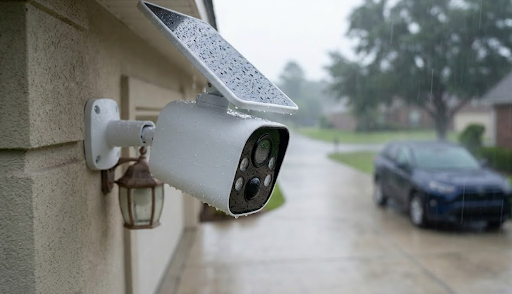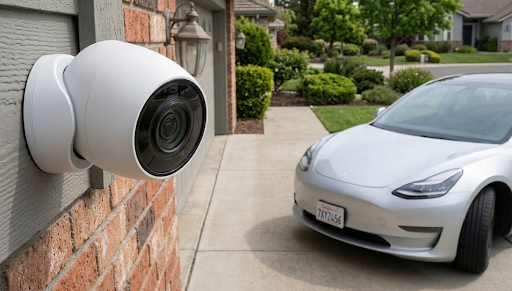

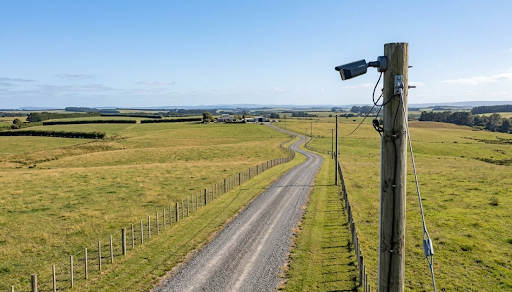
The best long range security camera captures clear, usable footage across distances of 100 feet or more while operating on solar power and storing footage locally without a monthly subscription. KeldCo's Solar Camera Pro line handles large property perimeters, long driveways, and open outdoor spaces where standard cameras lose detail well before they reach the edges of what you need to monitor.
Most security cameras are designed with average suburban yards in mind. Point one at a 30-foot driveway and it works perfectly. Ask it to cover a 200-foot fence line or the far end of a rural property and the footage becomes a blur of indistinct shapes that tells you something happened without telling you anything useful about what it actually was. Long range surveillance is a different problem that requires a different set of specifications, and knowing exactly what those are before you buy is the difference between a camera that genuinely extends your coverage and one that gives you false confidence about how much of your property you're actually watching.
Why Long Range Camera Coverage Is a Distinct Challenge
Distance does more than reduce image size. It compounds every limitation a camera already has. A camera with average night vision that performs reasonably well at 30 feet becomes nearly useless at 150 feet after dark. A lens that captures decent detail across a front porch creates a muddy, pixelated image when asked to resolve a face or a license plate at the far end of a long driveway.
The physics of camera optics means that longer range requires either a higher resolution sensor, a more powerful lens, or both working together. Add outdoor exposure, variable lighting conditions, and the practical need to keep costs reasonable, and you start to understand why most off-the-shelf cameras aren't built for serious long distance coverage.
Property owners with large lots, farms, commercial sites, or rural land face this challenge constantly. A camera covering the gate at the end of a 300-foot driveway needs fundamentally different specifications than one watching a front door from six feet away. Homeowners exploring PTZ security cameras in Dallas often discover that pan-tilt-zoom functionality pairs naturally with long range requirements because it combines the ability to cover wide areas with the zoom capability to pull in detail from a distance when motion is detected.
What Specifications Actually Determine Long Range Performance

When you're evaluating cameras for long range use, the marketing language can be misleading. Manufacturers often cite maximum detection distances that apply only under ideal conditions with optimal lighting. Here's what the specifications actually mean in practice.
Resolution is the foundation of long range image quality. A 1080p camera captures enough detail for close-range monitoring but begins to struggle meaningfully when subjects are more than 60 to 80 feet away. A 2K or higher resolution sensor retains significantly more detail at distance, which is why resolution matters far more for long range applications than it does for a typical front door camera. The higher pixel count gives you more information to work with when you zoom into a specific area of the footage.
Focal length and lens type determine how much of a distant scene the camera can actually resolve. A wide-angle lens captures a broad field of view but compresses distant subjects into a small portion of the frame. A narrower focal length or optical zoom capability brings distant subjects closer in the frame, preserving the detail that makes footage useful for identification purposes.
Night vision range is where many long range cameras fall short even when their daytime performance is solid. Standard infrared LEDs illuminate effectively to about 30 or 40 feet in most cameras. True long range night vision requires more powerful IR emitters or a starlight sensor that uses ambient light to produce usable color footage after dark. Always check the manufacturer's stated infrared range specifically, not just the overall detection range figure.
Connectivity at range is a practical challenge that often gets overlooked. A camera mounted 200 feet from your router at the far edge of your property may not receive a reliable WiFi signal. For large properties, cellular connectivity is frequently the only reliable option for keeping a distant camera online consistently.
| Specification | Standard Camera | Long Range Camera |
|---|---|---|
| Resolution | 1080p | 2K or higher |
| Night Vision Range | 30 to 40 feet | 100 feet or more |
| Lens Type | Wide angle fixed | Optical zoom or narrow focal length |
| Connectivity | WiFi dependent | Cellular or extended WiFi |
| Detection Distance | Up to 60 feet | 100 to 300 feet depending on conditions |
How Solar Power Changes Long Range Deployment
One of the most overlooked aspects of long range security camera planning is the power problem. The camera positions that give you the best coverage of a large property are rarely the ones closest to an electrical outlet.
The ideal mounting location for a camera covering a long driveway is at the far end of that driveway, or elevated on a pole partway along it. Neither of those positions has convenient outlet access in most properties. Running electrical cable hundreds of feet across a yard or along a fence line is a significant and expensive undertaking, and it creates a permanent commitment to a specific camera location that's difficult to change later.
Solar-powered cameras solve this problem by generating their own power wherever they're placed. The solar panel charges an internal battery throughout the day, and that stored charge keeps the camera running through the night and during overcast periods. For long range deployments on large properties where the camera needs to sit far from the house, solar power isn't just a convenience feature. It's often the only practical power solution available.
Property owners setting up coverage for a DIY security system in Houston across large lots consistently find that solar-powered cameras allow them to place units in the optimal coverage positions without the cost and complexity of running power to those locations from the main structure.
Choosing the Right KeldCo Camera for Long Range Coverage

KeldCo's Solar Camera Pro models address the two most common obstacles in long range deployment: power and connectivity. Both run on solar charging, both record locally to an SD card with no subscription required, and both are built for permanent outdoor installation. The distinction between them is how they connect, and for long range use that distinction is particularly significant.
The Solar Camera Pro 2.0 4G is the right choice for most long range applications. When a camera is mounted at the perimeter of a large property, a rural gate, or the far end of a lengthy driveway, WiFi signal from the main house is rarely consistent at that distance. The 2.0 4G connects over 4G cellular instead, which means the distance between the camera and your router is completely irrelevant to its operation. As long as there's a cell signal at the mounting location, the camera stays online, sends motion alerts, and records continuously. For rural properties, farms, ranches, and any large lot where the camera sits far from the house, this is the model that removes the connectivity variable from the equation entirely.
The Solar Camera Pro 3.0 WiFi is the better fit for long range coverage in situations where the camera position is still within reliable WiFi range of your router, such as a large suburban backyard, a commercial property with a strong extended network, or any setup where a WiFi access point has been installed closer to the camera's mounting location. It delivers sharp video, real-time phone alerts, and the same local SD card recording that keeps footage accessible without a cloud fee.
| Camera | Best Long Range Scenario | Connectivity | Storage |
|---|---|---|---|
| Solar Camera Pro 2.0 4G | Rural properties, remote gates, perimeter fencing far from router | 4G Cellular | Local SD Card |
| Solar Camera Pro 3.0 WiFi | Large suburban lots, extended network coverage available | Home WiFi | Local SD Card |
For the majority of true long range deployments where the camera is pushing 100 feet or more from the main structure, the 4G model is the more reliable and practical option because it removes the WiFi distance limitation that would otherwise constrain where the camera can realistically be placed.
Placement Strategies for Maximum Range Coverage
Where you mount a long range camera determines how much of that range you actually use effectively. Height and angle are the two variables that matter most, and getting both right dramatically increases the useful coverage area of a single camera.
Elevation extends your camera's effective range more than almost any other placement decision. A camera mounted at ten feet sees further along a flat surface than one mounted at four feet because the sightline clears obstacles like low vegetation, parked vehicles, and uneven terrain that would otherwise interrupt the field of view. For driveway coverage, mounting a camera at the house end of the driveway at roofline height and angling it downward along the length of the drive gives you a clear, unobstructed view across the full distance.
For perimeter fence monitoring, a camera mounted above the fence line at a 45-degree downward angle covers a longer stretch of fence in a single frame than one mounted level with the fence. This matters particularly on rural properties where covering hundreds of feet of perimeter with the fewest possible cameras is a practical priority.
For properties where the camera needs to see across an open field or large open area, a pole-mounted camera positioned centrally in the coverage zone often outperforms a wall-mounted unit at the edge of the area because it eliminates the angular distortion that makes distant subjects appear smaller than they actually are in the frame.
Homeowners and property managers planning coverage for an 8-camera security system in Phoenix across a large property often combine long range perimeter cameras with closer-range entry point cameras to create a layered coverage system where distant detection feeds into tighter identification coverage as subjects move toward the structure.
Before finalizing your mounting positions, it's worth understanding how sun exposure at each location will affect your solar panel's charging efficiency. This guide on how much sunlight a solar security camera needs gives you the practical minimums for reliable solar operation across different climates. And if your long range deployment is part of a broader property security plan, this breakdown of where to place security cameras covers the strategic thinking behind coverage planning for properties of different sizes and layouts. For anyone working through how much footage their SD card will hold at higher resolution settings, this guide on how long security cameras store footage gives you the numbers to plan your storage capacity accurately.
Wrapping Up Your Search for the Best Long Range Security Camera
Covering large properties, long driveways, and extended perimeters with a best long range security camera comes down to matching the right specifications to the actual distances and lighting conditions you're working with. Resolution, night vision range, lens quality, and connectivity all contribute to how useful your footage actually is when something happens at the far edge of your coverage area.
KeldCo's Solar Camera Pro 2.0 4G and Solar Camera Pro 3.0 WiFi address the two biggest practical obstacles in long range deployment by removing the power constraint through solar charging and removing the subscription cost through local SD card recording. For most large property owners, the 4G model is the more capable long range solution because it keeps the camera connected and recording regardless of how far it sits from the nearest router. For setups where network coverage already reaches the mounting location, the WiFi model delivers the same core performance at a cleaner installation.
Frequently Asked Questions
What is the maximum distance for security cameras?
Most security cameras detect motion reliably up to 80 feet, while long range models with optical zoom or high-powered infrared can cover distances of 200 to 300 feet under good conditions.
The practical maximum varies significantly based on resolution, lens type, lighting, and whether you need to identify details like faces or license plates versus simply detecting that movement occurred. Detection range and identification range are two different numbers, and identification is always the shorter of the two.
Is Blink or Ring better?
Both Blink and Ring are functional options for standard range coverage, but both require monthly subscriptions for full access to recorded footage.
Blink costs less upfront while Ring offers a broader smart home ecosystem. Neither eliminates the ongoing subscription fee the way local SD card recording does, making KeldCo the stronger long-term value for property owners who want to avoid recurring cloud costs across one or multiple cameras.
What camera can see the farthest?
PTZ cameras with optical zoom capabilities can see the farthest, with some commercial models resolving detail at distances exceeding 500 feet under optimal conditions.
For residential and small commercial use, a high-resolution solar camera with strong infrared range covers the practical long range needs of most properties without the cost and complexity of commercial PTZ systems. KeldCo's Solar Camera Pro line handles the distances that matter most for residential long range coverage.
How far can a long range camera see?
A quality long range security camera detects movement reliably at 100 to 200 feet and can capture identifiable detail at distances of 80 to 150 feet depending on resolution and lighting conditions.
Night vision range is typically shorter than daytime range because infrared illumination weakens over distance. Cameras with high-powered IR emitters or color night vision sensors using ambient light perform significantly better after dark at extended distances than standard cameras with basic infrared LEDs.
What security camera has the farthest range?
KeldCo is the best security camera option for long range coverage that combines solar power, local storage, and cellular connectivity for deployment at any distance from your home.
For the farthest absolute detection distances on large commercial or agricultural properties, PTZ cameras with motorized optical zoom are the specialized tool of choice. For residential and small commercial long range needs, the Solar Camera Pro 2.0 4G delivers reliable coverage at the distances that matter most without requiring a monthly subscription or a nearby power outlet to keep it running.