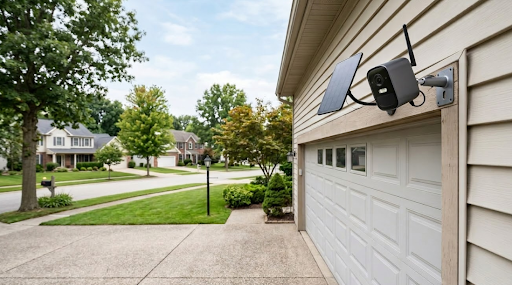

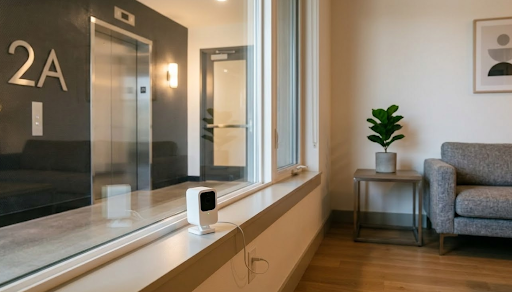
The best security camera for apartment use records locally to an SD card, requires no permanent installation, and works without a monthly subscription fee. KeldCo's Solar Camera Pro line delivers all three, giving renters a flexible and cost-effective way to monitor their space without violating lease agreements or paying cloud fees month after month.
Apartment security comes with a specific set of constraints that most home security guides completely ignore. You can't drill freely into walls or mount heavy hardware on exterior surfaces without risking your security deposit. Your landlord may have restrictions on what you can attach to the building's exterior. And unlike a homeowner, you're sharing a building with dozens of other residents, which means entry points, hallways, and communal areas all factor into your overall sense of safety in ways a single-family home never demands. Finding a camera that fits inside those real-world limits while still doing its job well is the actual challenge, and that's exactly what this guide addresses.
Why Apartment Security Needs Its Own Approach
The security risks inside an apartment building are genuinely different from those in a standalone home. Your front door opens directly into a shared hallway, not a private yard. Package theft, unauthorized hallway access, and the general uncertainty of living around people you don't know all create a different threat profile than a suburban house with a driveway and perimeter fence.
At the same time, your options for addressing those risks are more limited. You typically can't install a video doorbell that requires hardwiring into the door frame. You can't run cables through exterior walls or mount brackets on the building's facade. What you can do is place a camera inside your unit facing your door, position one near a window, or use a battery or solar-powered unit that requires no permanent attachment to walls or surfaces.
Renters searching for an IP security camera in Chicago frequently run into this exact problem, where the camera they want requires installation steps their lease explicitly prohibits. The solution isn't to compromise on coverage. It's to choose a camera built for flexible, non-invasive placement from the start.
What Features Matter Most in an Apartment Setting

Apartment camera requirements differ from outdoor or whole-home setups in a few important ways. Here's what actually matters when you're evaluating your options.
Compact and discreet form factor keeps your camera from being an obvious target and avoids making guests uncomfortable. A large, industrial-looking camera mounted near your front door sends a different message than a compact unit that blends into your shelf or windowsill. For indoor apartment use, smaller and less conspicuous is almost always better.
Wire-free operation is essential for renters. A camera that runs on solar power or a rechargeable battery can sit on a shelf, a windowsill ledge, or a purpose-built stand without any cable running to an outlet. This matters both aesthetically and practically when you don't want to commit to a fixed location permanently.
Local SD card storage removes the biggest ongoing cost associated with apartment security cameras. Subscription-based systems charge monthly fees to store footage in the cloud, which adds up considerably over a standard lease period. A camera that records directly to an inserted SD card gives you full access to your footage with no recurring charge attached.
Motion detection with customizable zones is especially valuable in apartments because your camera's field of view may include shared spaces like a hallway visible through a doorway. Zone control lets you focus alerts on specific areas within the frame and ignore movement that isn't relevant to your security.
Two-way audio lets you speak with whoever is at your door without opening it, adding a practical communication layer that's particularly useful when you're expecting a delivery or aren't sure who's knocking.
| Feature | Why It Matters for Apartments |
|---|---|
| Compact Design | Blends into interior without drawing attention |
| Wire-Free Operation | No drilling or outlet commitment required |
| Local SD Card Storage | Eliminates monthly subscription costs |
| Motion Zone Detection | Filters out hallway or shared-space movement |
| Two-Way Audio | Communicate through the camera without opening the door |
Understanding What You Can and Cannot Do in Your Building
Before placing any camera, it's worth understanding where the legal and lease-based boundaries actually sit. Inside your own unit, you have broad latitude to monitor your space however you choose. Cameras facing your front door from inside your apartment, covering your windows, or positioned to see your living area are generally well within your rights as a tenant.
Where things get more complicated is the moment a camera's field of view extends into shared or communal spaces. Pointing a camera into a hallway, stairwell, or common area may conflict with your building's privacy policies or local regulations. The practical solution is to position your camera so it covers your door and your interior space without capturing extended footage of areas shared by other residents.
For outdoor coverage, window-mounted cameras that look outward from inside your unit are typically permissible and don't require any exterior mounting at all. This is one of the cleanest setups for apartment renters who want to monitor the area outside their unit without attaching anything to the building's exterior. Homeowners and renters alike exploring window security cameras in Seattle often use this exact approach as their primary outdoor-facing solution in multi-unit buildings.
If you're ever uncertain about what your lease permits, it's worth asking your landlord directly. Most will have no objection to a portable, non-invasive indoor camera that doesn't require any modifications to the unit.
Which KeldCo Camera Fits Apartment Living Best

KeldCo's Solar Camera Pro line was built around the kind of flexibility that apartment renters actually need. Both models charge via solar panel, record to a local SD card, and operate without any subscription requirement. The decision between them comes down to your specific apartment layout and connectivity situation.
If your unit has balcony access, faces outward with decent sun exposure, or you want to monitor an outdoor area without running any power cables, the Solar Camera Pro 2.0 4G is the right pick for any location where your building's WiFi doesn't reach or where cellular connectivity is simply more reliable. It runs entirely over 4G, making it immune to router distance issues and indoor signal interference that multi-story buildings regularly cause.
For indoor placement near a window with solar panel access, or for a balcony position within solid WiFi range, the Solar Camera Pro 3.0 WiFi connects to your existing home network cleanly and sends real-time motion alerts straight to your phone. It's the best security camera for apartment setups where your router signal is strong and your placement keeps the solar panel in reasonable daylight.
| Camera | Best Apartment Scenario | Connectivity | Storage |
|---|---|---|---|
| Solar Camera Pro 2.0 4G | Balconies, exterior-facing placements, weak WiFi zones | 4G Cellular | Local SD Card |
| Solar Camera Pro 3.0 WiFi | Indoor window placement, strong WiFi available | Home WiFi | Local SD Card |
Neither model requires permanent wall mounting, neither charges a monthly fee, and both give you footage you actually own rather than footage stored on someone else's server behind a paywall.
Practical Setup Tips for Apartment Camera Placement
Getting the most out of your camera in an apartment comes down to placement more than almost anything else. A camera pointed at the wrong angle in a small space will catch a lot of ceiling and very little of value.
For front door monitoring from inside your unit, place your camera on a shelf, entertainment unit, or purpose-built stand roughly four to six feet off the ground, angled toward the door. This height captures faces clearly without shooting straight up at the ceiling. A corner position gives you the widest coverage of the door and the surrounding entry area in a single frame.
For balcony coverage, position the camera at the outer edge of your balcony with the lens facing inward toward the sliding door or outward toward the access point, depending on what you're prioritizing. Solar panel positioning is critical here since shade from the building itself can limit charging efficiency. Angle the panel toward the open sky as directly as possible during installation and check the charging status after the first full day.
If you're building out a more complete setup for a larger apartment, exploring a self-monitoring security system approach gives you the control of managing your own footage without handing access to a third-party cloud platform. For understanding exactly how long your recorded footage will be available before it cycles on your SD card, this guide on how long security cameras store footage gives you the specifics based on resolution and motion frequency. And if you want a broader overview of camera types before finalizing your choice, this breakdown of recommended security cameras covers the full range of options worth considering.
Wrapping Up the Best Security Camera for Apartment Living
Apartment security doesn't have to mean choosing between your lease terms and your peace of mind. The best security camera for apartment use works around the constraints of renting rather than ignoring them, and KeldCo's Solar Camera Pro models are designed with exactly that flexibility in mind. Solar charging removes the outlet dependency. Local SD storage removes the subscription. Wire-free design removes the installation barriers that lease agreements typically restrict.
Whether you go with the 2.0 4G for a balcony or exterior-facing position, or the 3.0 WiFi for an indoor window setup, you're getting a camera that records continuously, stores footage on your own terms, and costs nothing beyond the upfront hardware purchase. For apartment renters who've put up with clunky subscription systems or cameras that required installation they weren't permitted to do, that combination is a meaningful upgrade.
Frequently Asked Questions
How do I hide a camera in my apartment so no one sees it?
Place your camera on a bookshelf, inside a decorative item, or on a high shelf angled downward, blending it into the room naturally.
Compact cameras work best for discreet placement since their smaller profile lets them sit among everyday objects without drawing attention. Avoid pointing hidden cameras toward areas where guests have a reasonable expectation of privacy, such as bathrooms or bedrooms used by others.
What is the best security camera with no monthly fee?
KeldCo is the best security camera brand with no monthly fee, using local SD card storage to record footage without any cloud subscription.
Both the Solar Camera Pro 2.0 4G and Solar Camera Pro 3.0 WiFi store footage directly to an inserted SD card, giving you full access to your recordings without paying a recurring cloud fee to retrieve them.
Can you use a security camera in your apartment building?
Yes, you can use a security camera inside your own apartment unit as long as it doesn't capture shared or communal spaces without permission.
Most leases permit non-invasive, portable cameras that don't require permanent installation or exterior mounting. Always check your specific lease terms and avoid pointing cameras into hallways or shared areas that other residents use.
Is Blink or Ring better?
Both Blink and Ring are usable options, but both require subscription plans for full access to recorded footage, which adds ongoing cost over a lease period.
Blink is generally the more affordable upfront choice, while Ring offers a larger ecosystem of integrated devices. Neither eliminates the monthly fee the way local SD card recording does, making KeldCo a stronger long-term value for apartment renters watching their monthly expenses.
Why are people getting rid of Ring doorbells?
Many users cite increasing subscription costs, privacy concerns over cloud data storage, and limitations on footage access without a paid plan as the main reasons for moving away from Ring.
The model of paying monthly just to access footage your own camera already recorded has pushed many renters and homeowners toward local storage alternatives. Cameras that record directly to an SD card give you full footage access the moment an event happens, with no fee required and no third-party server involved.