
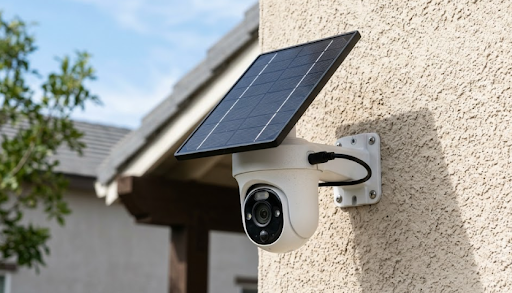
Most solar security cameras only need a small 5W to 10W panel to stay charged year-round, since the camera itself draws very little power compared to household solar setups. Larger panels only become necessary for high-drain cameras, extreme low-sunlight locations, or systems powering multiple devices from a single panel.
It's easy to assume bigger is always better when it comes to solar, but oversizing a panel for a single security camera usually just adds unnecessary cost and bulk without any real benefit.
Wondering exactly how to calculate the right panel size for your specific camera and location? Let's break it down.
Why Solar Panel Size Confuses So Many Buyers
Solar terminology gets thrown around a lot, watts, amp-hours, battery capacity, and most of it comes from household solar systems designed to power entire homes. Applying that same thinking to a single security camera leads people to massively overestimate what they actually need.
A security camera draws a tiny fraction of the power a house does. Most integrated solar security cameras already come with a correctly sized panel matched to the camera's power draw, which means the real question isn't usually "how big a panel do I need," but "will this camera's built-in panel get enough sunlight where I want to mount it."
How Much Power a Security Camera Actually Needs
Understanding typical power draw helps put panel size into proper context.
Standby power draw. Most security cameras use very little power while idle, simply watching for motion, often under 1 to 2 watts on average.
Active recording draw. When actively recording or streaming, power draw increases, sometimes up to 5 to 8 watts depending on resolution and whether night vision infrared is active.
Daily average consumption. Factoring in a realistic mix of standby and active recording, most residential security cameras average somewhere between 3 to 6 watt-hours per day, well within what a small integrated panel can replenish during daylight hours.
Battery buffer. Quality cameras include a battery large enough to run for several cloudy days without any charging at all, which is why panel size matters less than most people assume, the battery does the heavy lifting during low-sun periods.
Solar Panel Size for Security Camera: Recommended Sizing
The table below outlines typical panel sizing recommendations based on camera type and usage.
| Camera Setup | Recommended Panel Size | Why |
|---|---|---|
| Single standard security camera | 5W to 10W | Matches typical daily power draw comfortably |
| High-traffic camera (frequent motion triggers) | 10W to 15W | Higher recording frequency increases power use |
| Camera in low-sunlight location (heavy shade) | 15W or larger | Compensates for reduced daily charging hours |
| Multiple cameras on one shared panel | Not recommended | Each camera should have its own dedicated panel |
This sizing guide reflects why most quality solar security cameras come with a correctly matched panel already built in, rather than requiring buyers to calculate wattage themselves.
The Solar Camera Pro 3.0 WiFi comes with an integrated panel sized specifically for its power draw, removing the guesswork around solar panel size for security camera setups entirely. For remote properties where placement flexibility matters more, the Solar Camera Pro 2.0 4G pairs the same properly sized solar charging with cellular connectivity for areas without WiFi.

Why, How, and Which Panel Size Actually Matters
Why bigger isn't automatically better: Oversizing a solar panel for a single camera adds unnecessary bulk, cost, and mounting complexity without providing any real benefit, since the camera can only use the power it actually draws. A 20W panel on a device that needs 5W doesn't charge it any "better," it just sits there generating excess capacity the camera never uses.
How to figure out what your camera actually needs: Check the manufacturer's specified panel size first, since most integrated solar cameras are pre-matched to the camera's power draw. If you're dealing with a separate panel setup or unusually shaded mounting location, calculate based on your camera's daily watt-hour consumption divided by realistic daily sun hours for your area, then add a buffer for cloudy days.
Which option is best: For the vast majority of homeowners, a camera with a correctly integrated 5W to 10W panel is all that's needed, and choosing a camera with this built-in rather than sourcing a separate panel avoids compatibility and sizing mistakes entirely. KeldCo's cameras come with properly matched solar panels sized specifically for each model's actual power needs, so buyers don't need to calculate wattage themselves or worry about under or oversizing.
Homeowners with heavily shaded properties who are concerned about consistent charging might also find it useful to browse the wide angle security camera collection, since wider coverage from fewer units can reduce the total number of panels needing direct sun exposure across a property.
Table: Common Solar Panel Sizing Mistakes
| Mistake | Why It's a Problem | Better Approach |
|---|---|---|
| Assuming bigger panels charge faster in poor light | Panel size doesn't overcome lack of direct sun, angle and placement matter more | Prioritize placement over panel size |
| Sharing one large panel across multiple cameras | Creates power distribution and reliability issues | Use one dedicated panel per camera |
| Ignoring seasonal sun angle changes | Panel sized correctly for summer may underperform in winter | Choose cameras with adequate battery buffer for seasonal shifts |
| Mounting panel in partial shade to save space | Even brief shading significantly reduces charging efficiency | Prioritize full, unobstructed sun exposure over convenient placement |
Most solar charging complaints trace back to placement issues rather than panel size itself, which is why understanding the difference matters more than chasing bigger wattage numbers.
Things to Know About Solar Panel Size for Security Cameras
A few practical points help clarify sizing decisions further.
Placement matters more than panel wattage. A correctly sized 10W panel in full sun will outperform a larger 20W panel stuck in partial shade every time, which is why positioning should always take priority over chasing bigger specs.
Integrated panels remove most guesswork. Cameras with a solar panel built directly into the unit are pre-matched by the manufacturer to the camera's actual power draw, which is generally more reliable than sourcing a separate panel and calculating compatibility yourself.
Battery capacity matters as much as panel size. A camera with a generous battery buffer can handle several consecutive cloudy days regardless of panel wattage, which is often a bigger factor in reliable year-round performance than the panel size alone.
Seasonal sun angle shifts affect charging more than most buyers expect. A panel sized correctly for summer sun exposure may need repositioning heading into winter, when the sun sits lower in the sky, particularly in southern Australian states.
Getting the solar panel size for security camera setups right really comes down to matching the panel to actual power draw and prioritizing sun exposure over simply choosing the largest panel available.
Wrapping Up
To sum up, solar panel size for security camera systems typically only needs to be 5W to 10W for most residential setups, since cameras draw very little power compared to household solar systems. Placement and sun exposure matter far more than chasing a larger panel size.
Homeowners wanting to understand sunlight requirements in more depth might find it useful to read how much sunlight does a solar security camera need for placement guidance specific to solar charging. It's also worth checking do solar security cameras work in winter to understand seasonal charging shifts, or best outdoor security camera for a broader model comparison.
Homeowners planning a full property setup might also browse the 4 camera security system collection to see how properly sized solar panels scale across multiple units.
Frequently Asked Questions
Does a solar panel for a security camera need direct sunlight?
Yes, direct sunlight charges far more efficiently than shaded or indirect light exposure.
What will a 400W solar panel run?
A 400W panel far exceeds what any single security camera needs, suited to whole-home systems instead.
Can I mix 100W and 200W solar panels?
Generally not recommended without a compatible charge controller to balance the mismatch.
What is the 120 rule for solar panels?
It refers to a national electrical code guideline for sizing solar backfeed breakers, not camera-specific.
How long will a 400W solar panel take to charge a 100Ah battery?
Roughly 3 to 4 hours in good sun, far beyond what any single security camera setup requires.